Armitstead: The Place and the Name
by Kenrick ArmitsteadIN THAT PART of the West Riding of Yorkshire which spills over the Pennines
and reaches to within eleven miles of Morcombe Bay lies the ancient parish
of Giggleswick. It is in the basin of the river Ribble, normally thought
of as a Lancashire river although in its upper reaches it flows through
one of the loveliest of the Yorkshire dales. The Eastern boundary of the
parish is formed by the watershed of England, while to the west lie the
trackless wastes of the Bowland Forest. To the north rise the peaks of
Ingleborough and Penyghent, and the southern part of the parish was marsh
and lake until comparatively recent times. As a result it was very isolated,
and it was not until the construction of the Keighley and Kendall turnpike
in 1770 that heavy wheeled vehicles were able to enter it. Before this
the inhabitants had to rely on packhorse transport, and the population
remained fairly static over the centuries.
Giggleswick was a Norse settlement, the wick or village of Gikel, while
the neighbouring town of Settle was Anglian. The Anglians came first into
what was previously British Territory, followed by the Norsemen or Vikings,
but the even distribution of old English and Norse place names suggests
that there was peaceful coexistence between them. In Alfred's reign the
area became part of the Danelaw. Craven, as this part of Yorkshire is know,
is described in the Domesday Book, when it appears to have been an independent
district not yet incorporated into the county of Yorkshire. The four northern
counties were not mentioned at all, and Craven must have lain at the extreme
north of William I's realm.
Astride the boundary between Giggleswick and Clapham, its western neighbour,
lies the farmhouse known as Armitstead. There was originally a hamlet here,
but all that remains of it is the farm together with outbuildings containing
various remains of previous houses. The name Armitstead comes from Hermitstead,
the dwelling of the hermit, the sound Er having undergone a change in pronunciation
as in Derby and clerk, and Armitage which was originally Hermitage. The
Armitstead family took its name from the hamlet, and there was a branch
of the family still living there in the seventeenth century.
Earliest Reference
I have read that the first reference to the family is in the hundred rolls of 1273 where the name of Robert Armitstead appears, but the first one I have found so far appears in the poll tax returns of 1377. The poll tax was introduced in this year by Richard II, with a flat rate of one groat (fourpence) per head for all adults over 16, clergy and paupers being exempt. In 1379 a sliding scale was introduced, with the basic rate remaining at fourpence, while tradesmen and artisans paid 6d, farmers, merchants and innkeepers 1/-, and franklins forty pence. A franklin was a farmer not of gentle birth who owned his own land, and in 1379 Laurence de Armitstead was the only franklin in Giggleswick the highest taxpayer in the village apart from Robert Stainford, the lord of the manor, who paid one pound. The highest tax in the land was paid by John of Gaunt, the king's uncle (an ancestor, as will appear later) who paid £6.13.4 (ten marks). It is interesting to note that the total tax levied in Giggleswick, with a tax-paying population of 355, was £4.11.8, almost as much as that of Leeds, Huddersfield and Halifax combined.Another Armitstead, John, is mentioned in the 1379 Poll tax return, so the name would appear to have become a surname by then rather than just a place of residence. Surnames were introduced into England by the Normans and were not in use in Yorkshire before the thirteenth century.
The Flodden roll of 1511 lists the men of Giggleswick called up at that time who presumably fought at the battle of Flodden Field against the Scots. Thomas, James and Oliver were required to provide themselves with a bow, while James Armitstead of Stainforth (he was obviously a man of property) had to have a bill, bow, able horse and harness.
By the time of the start of the parish registers in the middle of the 16th century the name Armitstead appears very commonly in and the surrounding parishes. It is interesting to see that by this time they occupied social ranks from yeoman (freehold farmers, previously known as franklins) and clergymen down to paupers. William Ermystead, a canon of St Paul's and chaplain to Queen Mary Tudor, was the founder of Ermystead's School at Skipton. He later became vicar of Fryerning in Essex. A grammar school was founded at Giggleswick in the 16th century and in 1553 the school's first charter gives Roger Armitstead of Knight Stainforth as one of the school's first governors. The Revd John Armitstead MA was headmaster of the school from 1685 to 1712. In the neighbouring parish of Horton-in-Ribblesdale John Armitstead, a yeoman farmer owning Dubcotes farm, founded a grammar school in the eighteenth century. The original building still stands next to the church, and his table tomb is in the churchyard. When I was there a few years ago the vicar told me that the endowment still provides a regular annual contribution to the funds of the village school.
An interesting sidelight on the religious disputes of the time is given by the following extract from a 1704 report of the monthly meeting of the Society of Friends (Quakers).
- "In or about the year 1652 or 1653, it was so ordered that one of the
messengers of Jesus Christ, named William of Dewsbury, came to a town called
Settle, in the West part of Yorkshire, on a market day, and stood upon
the cross, and proclaimed the terrible day of the Lord, which was hastening
and coming upon the ungodly and workers of iniquity, but he was soon pulled
down, and a great tumult was made, and he was much beaten and abused. But
after some time, being taken notice of by a man whose name was John Armitstead
(who is still living) was invited to go with him to his mother's house,
whose name was Alice Armitstead, being a widow, whither he went and lodged
there."
A few years later, in 1670, Christopher Armitstead was fined fifteen
shillings for attending a Quaker meeting.
There is an almost complete list of the churchwardens of the parish
from 1638 onwards. In the first 25 years the name Armitstead appears twelve
times, more than any other. The name also occurs frequently in the lists
of constables.
Lord Armitstead
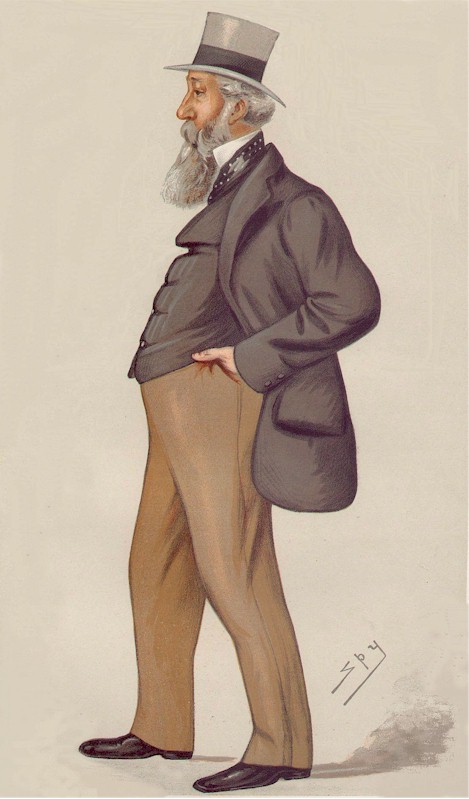
Lord Armitstead
drawn by Spy in 1882
- "He was born on February 28 1824. As a youth he refused to obey his
father, the vicar of Easingwold Yorks' wishes and injunctions to study
for the clerical profession, or even as a teacher at Giggleswick school
for the sons of gentlemen, but fled by night to the great North road, where
he was able to be of some assistance to a wealthy merchant of Dundee whose
coach had been beset by robbers. The merchant had carried him over the
border to his home, for he had taken a misguided liking to the stalwart
youth, who frequently bewailed his lot under a stern father. George was
offered a small place in the merchant's office, and quickly became a presbyterian,
on hearing which the Vicar of Easington immediately altered his will.
In seven years the boy, now 24, was admitted senior clerk, and five more saw him senior partner, (his benefactor now dead) in the firm of George Armitstead and Co, Dundee London and Riga, jute merchants, a flourishing concern. Being now received in the most respected circles, he wooed and won Miss Jane Baxter, the daughter of the First Lord of the Treasury, and took her to his new house, Castle Huntley, Longforgan, near Dundee. Wishing now above all things to found a family, he was much annoyed that Divine Providence, (rightly as we may believe) withheld from him the blessing of children. Soon Mr Armitstead began to neglect his saintly wife, of whom he was unworthy, and even so far forgot himself as to conceive a guilty passion for the daughter of the MacPherson of Cluny (15th chieftain of that clan). This laird soon becoming aware of his daughter's clandestine meetings, turned her out of doors. She was brought by Mr Armitstead to Castle Huntley, upon which his wife, who met then on the threshold, said: "Either that woman leaves this house or I do." Her husband replied (holding the fainting Miss MacPherson) "You do".
Thereupon Mrs Armitstead walked in a thin nightdress and slippers in a heavy snowstorm to the lodge, half a mile down the drive, and there craved from the good head gardener and his wife a shelter for the night. The next day she sought shelter at her father's house. These facts soon became known. All the servants gave notice, but on being offered double wages agreed to stay on. Dundee was now apprised of all that had happened, and Lord Kinnaird, the most prominent landowner thereabouts, cut Mr Armitstead before all the members of his club, and he was flouted by all. It was the death of the MacPherson that his daughter had become a public disgrace, but Providence so arranged in that the erring female died within three years.
Mr Armitstead (in order to forget his grief at this catastrophe) bought a yacht at Oban, a fine shoot, and a palatial house in London, at Cleveland Square, St James's. Finding these things empty and vain, he turned to politics and wormed his way into the good graces of the then Prime Minister, Mr Gladstone, for whom he paid on many continental tours. He was returned liberal MP for Dundee in April 1880, and had his portrait painted. It is now in the permanent collection of the Dundee Art Gallery. After giving £5,000 to the Prince of Wales Hospital Fund he was created (July 1906) Baron Armitstead of the city of Dundee, and bequeathed money for a chair of Philosophy at the university and a ward in the hospital. He died without benefit of clergy and lacking relation or friend to mourn him, at 4 Cleveland Square on Dec 15th 1915, when his barony became extinct.
"As the flower of the field, so he flourished, but as soon as the wind passed over it, it is gone and the place thereof shall know it no more".
In fact his nephew Henry Alfred Armitstead was present at the death.
The American Armisteads
The great family of Percy were the chief landowners in the area in the middle ages. The Armitsteads were numbered among their retainers, which is why several members of the family are to be found in the Kirk Deighton area, another Percy stronghold, from the fifteenth century. It was a member of this branch, who spell their name Armistead, and lived at Wetherby Grange, who emigrated to America in 1635, settling in Virginia. Many of his descendants had distinguished military careers in USA, and Colonel George Armistead was in charge of the force that prevented an English landing at Baltimore in the American War of 1812. There is a statue of him in Baltimore, and his victory inspired the writing of "the star-spangled banner". In the town of Williamsburgh is a house named Armistead which belonged to the family. The Baltimore Sun has stated "The Armistead family is one of the oldest, as well as one of the most distinguished, families in Virginia as also in America".A book entitled Armitstead Lineage published privately in Canada by Thomas Armitstead MM deals largely with his own branch of the family which originated in Newby, Clapham in the 17th century and subsequently emigrated to Ireland. It does also deal with the Cheshire branch, that of Lord Armitstead and the American Armisteads, and also gives useful extracts from parish records and lists of wills, but makes no mention of the branch spelling the name Armstead. This is the rarest of the three current spellings, Armistead being the most common. Henry Hugh Armstead was a famous sculptor who exhibited over 80 busts at the Royal Academy at one time or another and made the figures on the podium of the Albert memorial and the frieze round the dome of the Albert Hall.